대한민국 교육의 근본적 재정의: AI 시대의 인재 양성 및 선진국 비전 보고서
인공지능(AI) 기술이 전 산업과 일상에 깊숙이 침투하는 이 시대, 대한민국의 교육 시스템은 그 근본적 존재 이유와 방향에 대한 심대한 재정의를 요구받고 있습니다. 선진국으로의 도약은 첨단 기술 확보뿐 아니라, 이 기술을 책임감 있게 다룰 수 있는 성숙한 시민성을 길러내는 교육의 질에 달려 있습니다.
본 보고서는 AI 시대에 요구되는 인재상과 교육의 역할을 분석하고, 특히 보편화된 생성형 AI 사용 현실에 대한 교육적 대응 방안을 심도 있게 모색합니다.
- AI 시대를 위한 교육 개혁의 흐름 요약
대한민국의 국가 전략은 AI 기술 주도권 확보와 더불어 교육 시스템의 전면적인 혁신을 목표로 하고 있습니다. 이는 과거의 지식 전달 중심 구조를 벗어나 융합적 사고력과 실질적인 문제 해결 능력을 갖춘 인재를 배출하는 데 방점을 찍고 있습니다.
R&D 및 인프라 혁신 방향
국가 차원에서 AI 연구 협력을 위한 유연한 추진 체계 구축이 강조되고 있으며, '국가과학AI연구소' 설립을 통해 공공 AI 모델 확산의 허브 역할을 수행할 계획입니다. 또한, 연구자의 창의적 협업을 촉진하는 AI 연구 동료 플랫폼 개발이 병행되어 연구 효율성을 극대화하고자 합니다.
교육 시스템의 핵심 목표
초·중·고교 공교육에 AI 교육을 체계적으로 안착시키는 동시에, 대학 중심의 우수 인재 유치 정책을 통해 세계 최고 수준의 AI 인재 생태계를 구축하는 것이 목표입니다. 현재의 경직된 교육 체계로는 급변하는 산업 변화를 따라잡을 수 없기에, 융합적 지식과 사고력을 갖춘 인재 양성이 핵심 과제로 설정되었습니다.
- '교육용 AI' 도입의 명암
학교 현장에 '교육용 AI 도구'를 도입하는 것은 효율성과 접근성이라는 밝은 면과 함께, 공정성 및 인프라 격차라는 그림자를 드리웁니다.
교육용 AI 도입의 장점
교육용 AI는 이론 학습의 한계를 극복하고 학생들에게 실제 데이터를 다룰 수 있는 환경을 제공할 수 있습니다. 국가 단위의 데이터 실습 플랫폼 구축 논의는 교육용 AI가 이러한 실습 환경 지원의 중심축이 될 수 있음을 시사합니다. 또한, AI 피드백 학습 자원을 활용하면 학생 개개인에게 최적화된 맞춤형 학습 경험을 제공하여 학습 몰입도를 높일 수 있습니다.
교육용 AI 도입의 단점
가장 큰 우려는 교육의 공공성과 지속가능성입니다. 민간 기업이 제공하는 AI 플랫폼에 지나치게 의존할 경우, 교육 내용의 일관성 유지나 데이터 접근의 형평성 문제가 발생할 수 있습니다. 또한, 고성능 AI 인프라 구축에 투입되는 재정적 격차는 필연적으로 학교 간 디지털 격차를 심화시켜 교육 불평등을 초래할 위험이 내포되어 있습니다.
- 'AI 교육'을 통한 소양 및 역량 강화 분석
AI 기술을 교육과정에 통합하는 것은 미래 사회에 필요한 핵심 역량을 조기에 함양할 수 있는 기회이지만, 현행 시스템의 제약으로 인해 도입에 어려움이 따릅니다.
역량 강점 (Pros)
AI 교육의 가장 큰 장점은 학생들이 미래 사회의 필수 역량인 융합적 사고력, 문제 해결 능력, 그리고 AI 활용 역량을 조기에 확보하게 한다는 점입니다. 더불어, 초등 과정부터 AI 윤리 교육을 포함함으로써, 기술 발전에 따른 사회적 영향을 깊이 이해하는 책임감 있는 시민성을 기를 수 있습니다. 교육과정 자체도 기술 변화에 맞춰 유연하게 개편될 수 있는 개방적 모듈형 구조를 지향하게 됩니다.
역량 강화의 난관 (Cons)
현재 교육과정 개정 주기는 생성형 AI와 같은 기술 발전 속도를 도저히 따라가지 못하고 있습니다. 이러한 구조적 경직성은 교육의 시의성을 저해합니다. 더욱이, 현행의 점수 중심 평가 체계는 학생이 AI를 활용하여 문제를 해결하는 과정이나 창의적 융합 능력을 측정하고 보상하기 어렵다는 근본적인 한계를 지닙니다.
- 생성형 AI 사용에 대한 적극적 교육의 시급성
중고등학교 학생 90% 이상이 이미 생성형 AI를 일상적으로 사용하고 있다는 통계적 사실은, 이 기술을 학교 밖에서만 사용하도록 방치하는 것이야말로 가장 위험한 태도임을 역설합니다.
교육이 이 현실을 외면하고 회피한다면, 학생들은 AI가 생성하는 정보의 편향성, 윤리적 딜레마, 그리고 저작권 문제에 대한 비판적 숙고 과정 없이 기술에 종속될 위험이 있습니다. 이는 곧 미디어를 비판적으로 수용하지 못하고, 기술의 조작에 취약한 시민을 양산하는 결과를 초래합니다.
따라서, 피하지 말고 하루빨리 적극적인 교육을 진행해야 합니다. 학교는 AI를 금지하는 대신, 생성형 AI의 작동 원리, 한계, 그리고 활용의 윤리적 책임을 가르치는 주체적인 교육의 장이 되어야 합니다. 이는 자료에서 언급된 'AI 시대 국가교육 체계 혁신'의 가장 시급하고 실천적인 출발점입니다.
- 결론: 교육의 근본 재정의와 선진 대한민국 비전
선진 대한민국이란 첨단 기술의 양적 규모를 자랑하는 나라가 아니라, 그 기술을 가장 윤리적이고 창의적이며 인간 중심적으로 활용할 줄 아는 시민들이 공존하는 사회입니다.
교육의 근본적 정의는 이 지점에서 새로워져야 합니다. 교육은 더 이상 '암기된 지식의 총량'을 측정하는 수단이 아니라, 학생 스스로 사고하고, 지식을 비판적으로 융합하며, 시대의 난제에 맞설 수 있는 새로운 가치를 창출하도록 돕는 '지속 가능한 학습 플랫폼'으로 변모해야 합니다.
AI 시대의 인재는 특정 학문의 전문가를 넘어, 자신의 전문 분야에서 AI 도구를 능숙하게 활용하여 복잡한 문제를 해결하는 'AI 융합형 문제 해결사'가 되어야 합니다. 이 비전을 실현하기 위해, 대한민국의 교육 시스템은 현재의 모든 요소(교과과정 설계, 교원 양성, 그리고 평가 체계)를 AI와의 능동적 통합이라는 최우선 목표 아래 전면적으로 재정렬해야 할 중대한 기로에 서 있습니다.
This content scrutinizes the risks and challenges of establishing a safe digital education environment for students. You will gain actionable insights into protecting student personal information and privacy amidst rapid AI textbook adoption. Learn critical issues like insufficient data governance and international standards for children's digital rights compliance.
- AI 디지털교과서 정책 개요 및 특징
AI 디지털교과서 도입 목표: 맞춤 교육 실현을 위해 AI 등 첨단 기술을 활용하며, 교사의 역할 변화가 중요함 .
교사 역할 변화: 학생별 학습경로 이해 기반의 데이터 기반 참여형 수업 설계 및 개별 학습 제공 역할로 전환 필요 .
도입 일정 및 대상: 2025년 수학, 영어, 정보, 국어(특수 기술/가정) 우선 도입 후 2028년까지 확대 예정 .
초등 1~2학년군 및 심미/감성/능력 함양 과목(도덕, 음악, 미술, 체육)은 적용 제외 .
AI 디지털교과서 정의: AI를 활용하여 다양한 맞춤형 학습 기회를 지원하도록 자료 및 기능을 탑재한 교과서임 .
핵심 서비스: AI 기반 학습 진단/분석, 개인별 맞춤 학습, 학생 관점의 학습 코스웨어 제시 .
학생: 학습 진단, 최적 경로/콘텐츠 추천 .
교사: 수업 설계 및 맞춤 처방 지원 (AI 보조교사) .
공통: 대시보드를 통한 학습 데이터 분석 및 소통 지원 .
본질: 단순 교과서가 아닌, 데이터 기반 학습 관리 시스템으로 학생 데이터 광범위하게 수집/활용 .
개발 및 운영 주체: 민간 발행사가 개발하고 서비스 제공자가 인프라 운영/고객 서비스를 제공하는 형태임 .
수집된 데이터는 AI 디지털교과서 서비스 목적 외 사용 금지 및 인프라 분리 관리 필요성 제기되었으나 구체적 가이드라인/감독 기관 논의는 전무함 .
- AI 디지털교과서 개발 우려 및 국제사회 권고 사항
2.1. 아동 권리 관점에서의 개발 우려
학생 의견 반영 미흡: 교육부는 학생 참여를 언급했으나, 구체적으로는 사용자 경험 분석 및 디자인 씽킹 활용 수준의 절차만 제시됨 .
아동 권리 해석의 범위: 디지털 환경 아동 권리는 기회 보장뿐 아니라 위험 및 부정적 영향으로부터 보호받을 권리를 포함하며, 데이터 수집 및 활용의 적절성 논의가 필요함 .
핵심 미논의 사항: 학생 데이터의 범위, 보관/폐기 방법, 동의 획득 시기/방법, 동의 거부/철회 선택권 및 다른 학습 방법 보장 등이 논의되지 않음 .
2.2. 아동 보호를 위한 국제사회 권고사항
유엔아동권리협약 일반논평 25호: 디지털 환경에서 아동 권리 이행을 위한 구체적 권고 사항으로, 한국 정부는 이행 의무가 있음 .
차별 및 위험 방지: 아동이 디지털 기술 사용 중 혐오 발언 노출, 편견 기반 자동화 프로세스 위험으로부터 선제적 보호 조치 마련 촉구 .
신경 발달 고려: 디지털 기기 사용법에 대한 부모/교육자 조언 제공 권고 (아동기 뇌 가소성 영향 고려) .
사생활 보호의 중요성: 아동의 주체성/존엄성/안전을 위해 개인정보 수집 최소화 원칙에 따라 설계되어야 함 .
디지털 관행 규제: 정보 처리 자동화, 행동 추적 등 관행이 아동 사생활 침해할 수 있으므로 기업 규제 및 국가의 감시 의무가 중요함 .
의견 존중: 국가가 입법/정책 마련 시 아동의 견해를 존중하고 의견 청취 절차를 마련해야 함 .
유엔 일반논평 25호 주요 내용 (표 1)
간섭 허용 조건: 사생활 개입은 법률에 의한 합법적 목적, 개인정보 수집 최소화 원칙, 비례성 준수 시에만 허용됨 .
국가 조치: 강력한 정보 보호 장치, 처리 투명성, 독립적 감독, Privacy-by-design 적용 의무화 .
동의: 아동 연령/능력을 고려하여 데이터를 처리하기 전에 동의 여부를 편히 결정하도록 해야 하며, 보호자 동의 확인 절차 필요 .
권리 보장: 아동/보호자는 정보 접근, 수정, 삭제 권리를 보장받아야 하며, 동의 철회 권리도 보장되어야 함 .
정보 성격: 수집된 정보는 특정 목적 외 사용 금지 및 배타적 성격을 가져야 함 .
환경 확장: 제품/의류/장난감 등 연결된 환경 전반의 제품/서비스에 높은 수준의 보호 규정 적용 필요 .
감시 문제: 일상적/무차별적 감시는 금지되며, 감시 목적 달성 시 사생활 간섭 최소화 방안을 고민해야 함 .
익명성: 익명 활동이 유해 행위 은폐 수단이 되지 않도록 Safety-by-design과 Privacy-by-design 통합 접근 요구 .
상담 서비스: 예방/상담 서비스 이용 시 부모 동의 조건 면제 필요하며 높은 수준의 사생활 보호 유지 .
AI 디지털교과서 가이드라인 보안 문제: 교육부 가이드라인이 AI 윤리 원칙(안전 보장, 투명성, 프라이버시 보호)을 언급하나, 구체적 가이드라인 및 관리 감독 방안은 미제시 .
K-클라우드 지원: 과기정통부의 K-클라우드 프로젝트 지원은 에듀테크 산업 육성 목적이 강함 .
보안 인증: AI 디지털교과서 플랫폼은 학생 학적/학습 데이터 연계로 보안 중요하며, 보안인증 '중' 등급 이상 인프라 사용 의무화됨 .
등급 상향 필요성: 헬스케어 수준의 높은 인허가 준수사항 연구와 같이, 교육 분야 데이터 민감도에 따른 보안 모델 논의 및 연구가 시급 .
2.3. 학생 민감 정보 수집 및 EU AI 법 비교
수집되는 민감 정보: AI 디지털교과서 서비스는 학습 태도, 관심사, 학습 활동 상태, 학업 정서 등을 진단/분석하며, 이는 EU AI 법상 고위험 민감 정보에 해당함 .
경각심 부족: 민감 정보 포함에 대한 사회적 경각심 부족 및 정책 당국 논의 부재는 아동 개인정보 및 사생활 보호에 심각한 우려를 줌 .
필요 조치: 전문가 연구, 국민 숙의, 입법/감독 규제 기관 및 예산/인력 확보 등 시간 확보 필요 .
EU AI 법 (고위험 AI 시스템 준수사항): 교육 활용 AI 시스템을 고위험으로 분류하며 구체적 준수사항을 규정함 .
고위험 분류: 입학 결정, 교육 수준 평가, 부정행위 모니터링 등에 사용되는 AI 시스템이 해당 .
위험 경고: 고위험 AI는 개인의 진로 결정에 영향을 미치며, 사생활 침해 문제(intrusive) 및 역사적 차별 패턴 영속화 우려가 있음 .
주요 준수사항: 위험 관리 시스템 (생애주기 위험 관리, 완화 조치), 데이터 거버넌스 (편향 조사), 기술 문서화, 기록 보관, 투명성 제공, 인간의 감독 설계가 필수적임 .
- 디지털 서비스 제공업체 대상 국제 가이드라인
OECD 디지털 서비스 제공업체 가이드라인 (2021)
핵심 요구: 아동 최선의 이익 우선, 연령에 적합한 안전 조치 설계 반영, 프로파일링/자동화된 의사결정 금지 (플랫폼 포함) .
데이터 정보 제공: 개인 데이터 수집/공개/사용 방식에 대해 간결하고 연령에 적합한 언어로 정보 제공 .
사용 제한: 아동 최선의 이익 이행을 위해 데이터 수집 및 제3자 공개를 제한하며, 아동 복지에 해로운 방식으로 데이터 사용 금지 .
유니세프 아동 데이터 거버넌스 선언문 (2021)
10대 원칙: 아동 중심 거버넌스, 감시 및 알고리즘 사용 최소화 표준 준수, 아동 최선의 이익 우선, 18세 미만 보호 조치 확대 (동의 연령 무관) .
책임 전환: 데이터 보호 책임을 기업과 정부로 전환해야 함 .
협력 및 자원: 데이터 정책 수립 시 아동/지역사회와 협력, 구현을 위한 적절한 자원 제공 (데이터 보호 당국 및 규제 감독 자금 확보) .
지식 격차 해소: 데이터 거버넌스 규정이 증거 기반이 되도록 추가 연구 필요하며, 국가 간 국제 협력 강화 촉구 .
세계 프라이버시 총회 결의 (2021)
금지 행위: 아동 행동에 영향을 미치는 행위, 상업/광고 목적 데이터 사용/전송, 데이터 제공 유도 마케팅 기법 금지 .
설계 통합: 서비스 설계 시 아동 최선의 이익 증진 및 권리 존중 통합 필요; 추적 기능 기본 해제 및 연령 확인 메커니즘은 위험에 비례해야 함 .
구체적 조치: 개인정보 영향 평가, 데이터 암호화, 이해하기 쉬운 개인정보 설정, 지리적 위치/프로파일링 등 특정 옵션 기본 비활성화 제공 .
5Rights Foundation 국제 비교 연구 (2022)
참고 기준: 영국 ICO의 '이용자 연령에 적합한 온라인 서비스 설계 코드' (AADC) 내용 검토 필요 .
AADC 15가지 표준: 아동 최선의 이익 최우선, 데이터 보호 영향 평가 수행, 연령 인식 기반 접근, 투명성 확보, 기본 설정은 높은 수준의 개인정보 보호로 설정해야 함 .
데이터 관리: 데이터 최소화 원칙 준수, 지리적 위치 옵션 기본 끔, 프로파일링 옵션 기본 "끄기" 설정 필요 .
넛지/감시: 넛지 기법을 사용하여 개인정보 제공 유도 금지; 부모 모니터링 사실을 자녀에게 명확히 알려야 함 .
- 학생 안전 환경 조성을 위한 시급 과제
구체적 입법/정책/규제 조치 시급: AI 디지털교과서에서 수집/활용 가능한/해서는 안 될 민감 데이터 분류 및 정의가 필요하며, 시행령 등 법규 마련과 개발사 관리 감독 장치 구축이 시급함 .
국제 권고 참고: OECD, 유니세프, GPA, 영국 AADC 등 국제 사회 권고 및 법령을 참고하여 가이드라인을 개발 및 시행해야 함 .
관리 감독 체계 필요: 금융/의료계 수준의 높은 수준 거버넌스 및 보안 적용이 필요하며, 교육부/과기정통부 협력 및 독립 기관 설립을 위한 인력/예산 확보가 중요함 .
초·중등교육법 관련: 학교장은 학생 자료를 학생 및 보호자 동의 없이 제3자 제공 불가 (통계 목적 등 비식별화 예외 있음) .
- AI 디지털교과서 클라우드 보안 및 데이터셋 문제
보안 인증 등급 상향 필요: 현재 '중' 등급이나, 데이터셋 종류(국가 수준, 통합 대시보드, 학습이력, AI 트레이닝용)가 허브로 전송되므로 '상' 등급 수준의 보안 인증이 필요함 .
미흡한 현장 경각심: 현장 AI 코스웨어/플랫폼은 개인정보 보호 정책 및 안내가 미흡하며, 소비자원 수준의 전수 조사 및 모니터링/정보 공개가 필요함 .
생성형 AI 서비스의 심각한 취약점 (J서비스 사례)
개인정보 대량 노출: 교사가 그룹 코드를 공개하면 학생 이름, 과제물, 성적 등 개인/민감정보가 외부인에게 무제한 공개됨 .
참여 제약 없음: 그룹 코드로 신원 확인/수락 절차 없이 누구나 참여 가능하여 외부인이 학생 데이터에 쉽게 접근 가능함 .
그룹 공개: '그룹 공개' 활성화 시 학교 외부인도 활동 내용을 쉽게 볼 수 있음 .
규제 주체 부재: 문제점에도 불구하고 관리/감독 규정, 주체, 인력, 예산이 전무하여 학생 정보가 위험에 노출됨 .
- AI 코스웨어 교육적 활용의 성격 및 제언
6.1. AI 코스웨어의 본질 및 의존성 문제
용어 명확화 필요: '교과서' 명칭 대신 '교육용 플랫폼' 성격을 투명하게 설명하여 오해를 줄여야 함 .
기술 의존성 및 평가: 수업이 AI/디지털 기술 의존 및 데이터화 가능한 학습 결과에 치중한 평가에 머무를 위험이 있음 .
선택권 존중: 기술 활용은 학생/교사의 발달 목표 등을 고려하여 선택권이 보장되어야 하며, 부모의 가치도 존중되어야 함 .
균형 잡힌 수업 설계: 아날로그 방식(대면 상호작용, 손글씨 등) 병행 및 대체 활동을 가이드라인에 보완하여, 기술과 균형 잡힌 수업 선택 가능해야 함 .
인프라 대비: Wi-Fi 환경 제약 등으로 인해 핵심 학습 자료의 인쇄 편의성을 고려해야 함 .
연구 균형: 정책 자료가 AI 활용 장점만 강조하므로, 최신 연구 기반으로 균형 있는 교육을 보장해야 함 .
학습 결과물 보호: 학습 결과물(사진, 영상, 글)에 포함된 사생활/민감 정보 노출 방지를 위해 안전/사생활 보호 중심 설계 적용 및 보관/폐기 규정 보완, 쉬운 동의/철회 보장 필요 .
디지털 시민성 교육 의무화: 원격교육법에 의거, 디지털 미디어 문해 교육(접근, 이해, 비판, 소통 능력) 및 과도한 의존 방지 예방 교육을 필수 반영해야 함 .
생체 정보 기술 신중: 시선 추적 등 생체 정보 요구 기술은 학생 정서적 아동 학대 및 건강 위협 가능성이 크므로, 학계 의견 반영하여 신중히 접근해야 함 (생체 정보는 고위험 민감 정보) .
6.2. AI 코스웨어 활용 양상 및 한계
교사의 정서적 합리성: 에듀테크 활용의 핵심은 ‘도구의 합리성’보다 ‘교사의 정서적 합리성’이며, 교사는 학급 통제권 강화 시 에듀테크를 활용하는 경향이 있음 .
맞춤형 이해: 개별 맞춤형 도구와 개별 맞춤형 수업은 다른 차원이며, 현재 AI는 규칙 기반(rule base) AI로 진단 기능 없이 정답률 기반 난이도 조절 수준에 머무름 .
알고리즘 투명성 문제: AI 분석(수행률, 정답률, 습관, 정서 등)이 제공되나, 분석 내용의 꼭 필요한 정보 여부나 교사의 교육적 피드백 활용 방안에 대한 독립적 연구 부족 .
데이터 상호운용성: 데이터 규모보다 '무엇을 학습으로 볼 것인가'에 대한 합의가 우선이며, 핀란드는 이를 위해 학습분석팀 설치 및 프레임워크 발간으로 명확히 함 .
기초학습부진 학생: 신기효과 이후 이탈이 많고, 현재 AI 코스웨어는 수준의 정교함이 없는 무작위 수준별 맞춤으로 자기주도성 해결에 한계가 있음 .
상위권 학생: 규칙적 습관 학생에게는 예/복습 도구로 유용하나, 킬러 문항 대비 불가 및 표준화된 정답지 수준의 피드백 한계로 사교육 대체 불가 의견이 높음 .
특수학교 학생: 장애 학생을 위한 맞춤형 에듀테크 부족하며, 일반 제품은 지적 능력이 우수한 일부 학생에게만 제한적으로 유용함 .
교사의 역할: 현재 AI 코스웨어는 교사의 역할을 협소하게 제한하며, 단순 업무 경감 도구로 환영받을 수 있으나, 교사가 얻는 통찰력을 놓칠 수 있음 .
학습의 성격: 현재 AI 코스웨어는 행동주의적/교수 중심적 접근으로, '왜(why)' 학습해야 하는지에 대한 이해를 제공하지 못함 .
6.3. 안전한 디지털 교육환경 조성을 위한 제언
행위주도성 보장: 학습의 주체가 될 수 있도록 다양한 학습자의 행위주도성(agency) 보장해야 함 .
어려움 극복: 학습 어려움이 있는 학생들에게는 단순 수준 저하가 아닌, 가장 부족한 지점을 찾는 것이 핵심이며 이는 다양한 학습 방식 탐색에서 시작됨 .
증거 기반 정책: AI 공교육 통합 정책은 확실하고 신뢰할 수 있으며 이해충돌이 없는 증거 기반 정책 마련을 목표해야 함 .
교사의 교육적 책임 지원: AI 기술은 교사 업무를 대체하는 것이 아니라, 교사와 학생 상호작용이 필요한 부분에 집중할 수 있도록 지원하여 교육적 책임을 다하도록 도와야 함 .
- 기술 확산 속도와 교육 가치 변화
7.1. 기술 심화 및 인간 양태 변화
기술의 순환 구조: 기술은 사회 변화를 야기하고 이는 다시 새로운 기술을 촉발하는 되먹임(Feed Back Loop) 구조이며, 새로운 윤리 기준 요구가 대두됨 .
의사결정 구조 고도화: 첨단 기술은 과정생략형 또는 모의결정형으로 인간의 의사결정 단계를 지원하며, 최종적으로는 감독형 또는 기계가 문제를 예측/진단하는 문제인식형으로 진화함 .
디지털 심화로 인한 인간 양태 변화: 공감 능력 쇠퇴, 자기애 증가, 집중력 지속 시간 및 단기 기억 능력 상실 (산만), 고독 및 자살률 증가 위험 내포 .
양극화 심화: 필터버블 및 알고리즘 편향으로 확증편향이 강화되어 가짜 뉴스가 기승을 부리는 환경 조성 .
관계 단절: 온라인 관계 편리성으로 직접적 대인관계 형성을 주저하며 이성 관계 형성 기피 현상 증가 .
7.2. 안전한 디지털 교육 환경 고려 사항
기술 확산 속도 문제: 신기술 대중화 속도가 가속화되어 충분히 생각하고 적응할 시간 부재 (예: 페이스북 7년 만에 3배 성장) .
정보 수용 범위 초과: 정보 유통량 급증으로 인류가 수용할 수 있는 범위를 초과하여 맹목적 기술 도입 유발 .
미디어 진화 방향: 미디어는 생동감(Vividness)과 상호작용성(Interaction) 극대화 방향으로 진화하여 Flow 현상 및 과도한 의존성 유발 우려 .
접근의 질: 디지털 이용 역량 제고를 위해 인지적/경제적 자원 할당 필요하며, 단순 기기 보유를 넘어선 접근의 질이 중요함 .
인류-기술 관계 변화: AI 기술 개발로 기술이 인류와 일대일의 대등한 관계를 맺게 됨 .
미래 교육 정책 방향: 기계적 평등을 넘어 ‘포용’의 가치를 포함해야 하며, 디지털 이용 교육은 응용 방식 및 경험 훈련에 초점을 맞추는 Just-in-time 교육 패러다임으로 전환 필요 .
전략적 도구: 도구적 기술 → 정보적 기술 → 개인별/상황별 전략적 도구로서의 중요성 증가 .
경험 학습: 자전거 학습처럼 직접 실행하고 경험하는 현장 실습을 통해 몸에 체득하는 훈련이 되어야 함 .
실천적 지혜 추구: 기술에 대한 맹목적 신뢰를 삼가고, 기계적 판단이 불가능한 상황에서 최선의 판단을 내리는 실천적 지혜(Practical Wisdom) 추구가 유일한 공존 방안임 .
이카로스의 날개 교훈: 아무리 훌륭한 기술도 악용 시 파괴적 결과를 가져오므로 기술보다 올바른 생각과 의지가 중요함 .
This dives deep into the concerns surrounding the rapid rollout of AI digital textbooks and the critical need for robust student data protection.
Here are the main policy and regulatory takeaways from the source material:
Core Policy Tension: AI Rollout vs. Child Data Rights
The document frames the AI digital textbook as essentially a "data-based learning management system" that relies heavily on collecting and utilizing student data, including sensitive factors like learning attitudes and emotional responses.
Key Regulatory Gaps and International Benchmarks
High-Risk Classification & Consent: The EU's AI Act classifies AI systems used in education (like assessment) as high-risk. There is a major gap in Korean policy regarding clear definitions of sensitive data, mandatory parental consent procedures (including refusal/withdrawal rights), and establishing clear oversight/regulatory bodies.
Security Standards: The current cloud security certification for the platform ('Middle' grade) is deemed insufficient. The document suggests an upgrade to the 'High' grade security standard, similar to what is applied to financial or healthcare data, given the nature of the learning data being transmitted.
Design Philosophy: There's a strong call to adopt international best practices such as 'Safety-by-Design' and 'Privacy-by-Design' to ensure data minimization and protect student privacy from the initial design stage. This aligns with guidelines from the UN CRC General Comment 25, OECD Guidelines, and the UK's Age Appropriate Design Code.
Student Agency: Policy must ensure student agency is guaranteed, meaning learning personalization should not just be about technical adaptation but about giving students control, and that non-digital/analog learning options remain readily available and supported.
Given that this document highlights several legislative and regulatory needs, would you like me to:
Create a note summarizing these key policy recommendations?
Search the web for any recent developments or legislative actions in Korea concerning AI EdTech data privacy since this document was written (published in 2024)?
제가 지금 가지고 있는 자료(A)는 주로 AI 디지털교과서 도입에 따른 데이터 보호 및 윤리적 쟁점에 초점을 맞추고 있지만, 여기에서 언급된 내용들을 바탕으로 교육의 이상과 AI 시대의 새로운 문제를 먼저 정리해 볼 수 있습니다.
- 교육이란 무엇이며, 무엇이어야 하는가? (자료 A 기반)
문서에 따르면, 현재의 AI 코스웨어 중심 접근 방식은 지식의 전달(instructionist approach)에 치중되어 있으며, 이는 진정한 '학습(learning)'과 '가르침(teaching)'을 구성하지 못한다고 지적합니다.
따라서 자료에서 시사하는 바람직한 교육의 모습은 다음과 같습니다.
행위주도성(Agency) 보장: 학생 자신이 학습의 주체가 되어 자신의 학습을 스스로 주도하는 능력(agency)을 보장해야 합니다.
균형 있는 접근: AI와 디지털 기술을 대면 활동, 손글씨 쓰기, 구체물 활용 등 아날로그적 방식과 균형 있게 선택할 수 있도록 가이드라인이 보완되어야 합니다.
실천적 지혜: 기계적인 판단이 불가능한 상황에서 내리는 최선의 판단과 의사결정 능력, 즉 실천적 지혜를 추구해야 합니다.
- AI 시대에 새롭게 제기된 근본적인 문제는 무엇인가?
문서에서 가장 강력하게 다루는 문제는 기술 발전의 속도와 인간의 가치 사이의 불일치입니다.
기술 결정주의의 위험: 기술의 자율적 발전을 제어하기 어려워지면서, 기술이 인간을 '닦달'하는 처지에 놓일 수 있다는 철학적 우려가 있습니다.
데이터 편향 및 디지털 노동: AI 성능 향상을 위해 무분별하게 데이터를 수집하는 것이 학생들에게 무급의 디지털 노동을 시키는 것이라는 비판이 제기됩니다.
공교육과 민간 기업 논리의 충돌: AI 디지털교과서 개발이 에듀테크 산업 육성이라는 기업의 논리에 치우치면서, 학생 안전과 사생활 보호라는 공교육의 논리가 후순위로 밀릴 위험이 있습니다.
- '선진' 대한민국을 어떻게 정의할 것인가? (추가 정보 필요)
세 번째 질문은 교육적 이상을 넘어 국가 비전과 연결되는 중요한 문제입니다. 현재의 자료(A)는 기술 도입 시 윤리적 안전장치를 마련하는 것이 현재 시점의 '선진화된 조치'라고 제시합니다.
하지만 '선진 대한민국'에 대한 정의는 현재 시점의 정책적 담론을 포함해야 더 정확합니다.
This content details South Korea's aggressive policy shift toward AI integration across government and education sectors through 2026 and 2027. You will learn precisely how the government plans to establish a 'National AI Platform' and foster 'balanced, converged researchers' by Q1 2026. Discover the actionable roadmap for restructuring K-12 education, deploying AI research companions, and designing new evaluation systems to stay globally competitive.
South Korea's Aggressive AI Integration Roadmap (Through 2027)
- Science & Technology Innovation Framework Establishment
Establish Core Policy/Platform by Q4 2025 and Pilot Programs in 2026
This framework supports AI integration across the entire R&D process, aiming for systematic implementation starting Q1 2027 .
Develop Flexible R&D Project Management System by Q1 2026
Allows flexible adjustments to project direction/outcomes based on rapid global AI changes .
Establish 'National Science AI Research Institute' by Q1 2026
This institute will act as the hub for spreading public science data and models, enhancing national R&D competitiveness .
Develop AI Research Companions (LLM-based) by Q1 2026
Aims to enable scientists to collaborate creatively with AI, requiring high-quality data collection (literature, experimental data, expert reasoning) and an interaction support platform .
Develop Continuous Interaction Framework for AI Research Companions
Starts development in Q1 2026, with phased expansion and high-level refinement based on feedback from Q2 2026 onwards .
Foster Balanced, Converged Researchers in Science & Technology
Policy to nurture researchers proficient in domain expertise and AI, finalized by Q1 2026 .
Integrate Science & Tech Experts into AI Research Process Definition
Roadmap to involve experts in defining, solving, and evaluating research tasks, ensuring continuous interaction by Q1 2026 .
- AI Era National Education System Innovation Action Plan
The core national duty is reforming the K-12 public education system to establish AI readiness across all grades and nurturing/attracting top global talent through universities/graduate schools .
2.1. Reconstruct K-12 Curriculum and Textbook System
Curriculum Restructuring
Mandatory digital/AI literacy for all K-12 grades .
Establish K-12 Digital/AI Practical Education Platform .
Innovate AI Evaluation and College Entrance Examination Systems .
Innovate Teacher Training and Expand Computer Science Teacher Employment .
Redesign AI Gifted Education System .
Strengthen University/Graduate AI Talent Cultivation .
Promote AX Specialist Talent Attraction and Maintain Top Level .
2.2. Policy Recommendations for Educational System Restructuring
National Education Committee (NEC) to Discuss Innovation Plan by Q1 2026
Collaboration with Ministry of Science and ICT (MSIT) and Ministry of Education (MOE) .
The resulting innovation plan must be reflected in the National Education Development Plan scheduled for Q1 2027 to ensure tangible change .
2.3. Reconstruct K-12 Curriculum & Textbook System Details
NEC to Initiate Policy Research on Flexible Curriculum by Q1 2026
Research focuses on 'Open/Modular Structure' for maximizing autonomy and differing revision cycles based on technology speed .
MOE to Pilot Modular Curriculum and Teacher Training by Q2 2026
This follows NEC research, involving field testing and feedback .
Develop Transition Plan for Open Textbook System by Q1 2026
MOE to establish a consultative body (tentative) for textbook system improvement .
Establish ISP for National AI Practice Platform by Q2 2026
This platform will support teaching/learning, built collaboratively between state and local education offices .
Background: Current Curriculum Lag
The ~7-year curriculum revision cycle cannot keep up with the rapid emergence of generative AI (since Nov 2022) .
Static, knowledge-delivery systems struggle to foster problem-solving needed for AI/Data ethics .
2.4. Ensure Continuous Digital/AI Education Across All Grades
Policy Goal: Establish a consistent, continuous digital/AI education system from elementary through high school .
Current system is fragmented (e.g., AI taught only 1 year in middle school, optional in high school) .
NEC to Research Systematic K-12 AI Education Curriculum by Q1 2026
This research builds upon pilot school results from the MOE .
Pilot Continuous Digital/AI Education Schools Starting Q1 2027
MOE and NEC will establish guidelines ('AI Education Operation Guidelines') and verify the operation model .
Develop AI Ethics Content and Teacher Training
AI Ethics content must be integrated across the curriculum .
Teacher training must be prepared starting Q1 2026, with feedback provided by Q1 2027 .
2.5. Build K-12 Digital/AI Practical Training Platform
Need for Public Sector Platform: Current practical environments are hard for teachers to build individually, relying on non-profit private platforms with consistency limits .
MSIT to Finalize Budget/Plan by Q4 2026
MSIT will build the simulation environment by Q2 2027 and start prototype operation with pilot schools by Q3 2027 .
MOE to Design School-Level Operation Models by Q4 2026
MOE collects teacher feedback starting Q1 2026 .
Ministry of Trade, Industry and Energy (MOTIE) to Design Industry Linkage by Q4 2026
This includes content verification and linkage models with EdTech companies starting Q1 2027 .
NEC to Review Linkage Methods with Pilot Program Results by Q3 2027 .
2.6. Innovate Evaluation and College Entrance Exam Systems
Shift from Score-Centric to Competency-Centric Evaluation
Current systems fail to reflect problem-solving, collaboration, and AI utilization skills .
NEC to Discuss College Admission Reform Direction by Q3 2026
Linkage plans for comprehensive college entrance exams by Q4 2026 .
Support Essay-Style Evaluation (AI-Assisted) by MOE Starting Q1 2026
MOE will build AI data for essay evaluation and support local offices in building scoring support systems .
Train 10,000 Essay-Style Leading Instructors by Q4 2029
This involves developing training modules starting Q1 2026 .
2.7. Innovate Teacher Training and Leadership Capacity
Issue: Insufficient AI/Data literacy among pre-service teachers and low importance in existing exams; management perception gaps impact execution .
MOE to Enhance Teacher Training Institution Curriculum by Q2 2027
AI competency indicators must be included in the 7th cycle teacher training institution evaluation .
Expand In-Service Teacher Training Programs
MOE expands AI/Digital training for current teachers starting Q3 2026 .
Curriculums for AI-based STEAM integration and leadership training courses are being developed .
MSIT to Support Teacher Practical Tools by Q2 2026
MSIT develops technology-based training courses, starting operation in Q3 2026, in cooperation with MOE/local offices .
2.8. Expand and Strengthen Information Teacher Employment
Need: Shortage of specialized full-time Information teachers (especially in rural areas) prevents stable AI education delivery .
MOE to Conduct Information Education Status Survey by Q4 2026
This informs efforts to secure appropriate faculty numbers for digital talent cultivation .
Develop and Operate AI Education Training System by Q3 2026
Training levels (Basic-Advanced-Expert) are developed by experts .
Linkage support systems with university graduate programs in CS/AI will be introduced by Q4 2026 .
NEC to Discuss Mid/Long-Term Employment Policy Direction by Q4 2026
Local Offices of Education must analyze demand and expand teacher placement starting Q1 2027 .
2.9. Redesign AI Gifted Education System
Shift Focus: Move from Math/Science-centric specialization to AI-centric convergence in specialized high schools and gifted schools .
Develop AI Deep Research Groups in Gifted Programs by Q1 2026
These groups will operate across schools, universities, and industry starting 2027 .
MSIT to Outline AI Convergence Plans for Science High Schools by Q4 2026
This includes linking with university research institutions .
Select Gifted Students Based on AI Literacy by 2027
Local Offices of Education revise operation plans by Q1 2026 .
- University & Graduate School Talent Cultivation
3.1. Integrate Fragmented Government AI Talent Projects
Problem: Current government AI talent projects are fragmented across MSIT, MOE, MOTIE, leading to budget inefficiency and lack of strategic synergy/scale .
Solution: National AI Strategy Committee (NAS) must coordinate and adjust all related support projects by Q1 2026 .
AI is a General-Purpose Technology (GPT)
Demand is explosive not just for AI experts, but for professionals in all fields (Law, Medicine, Arts) using AI to solve discipline-specific problems .
3.2. Diversify University Education Models
MSIT to Convert AI-centric University Program to 'AI Central University' Program by Q1 2026
This aims to solidify business consolidation and expand software-focused universities .
MOE to Support Humanities/Social Science AI Integration Research by Q1 2026
This establishes an academic foundation for an AI-based human-centric society starting Q2 2026 .
Strengthen Industry-Academia Linkages for Internships by Q1 2026
MOTIE and MSIT collaborate to ensure educational outcomes link to industrial ecosystem needs, boosting student adaptability .
Establish Intensive Support Program for Early Talent Identification by Q1 2026
Aims to secure the world's top AI talent pool .
- AX Talent Cultivation for Industry Capacity Building
4.1. Addressing Industry Skill Gap and Polarization
Issue: AI adoption causes severe polarization between utilizing companies and non-utilizing companies (especially SMEs, 99% of firms), leading to stagnation due to lack of internal experts and dependence on external solutions .
Goal: Build comprehensive support to enhance AI utilization capacity for approximately 20 million industrial workers, focusing on manufacturing AX transformation .
Plan for Re-education and Career Transition
Develop industry-specific training courses using online, on-demand platforms by Q1 2026 .
Establish institutional guarantees for credit recognition/certification and corporate incentives for re-education pathways .
4.2. SME Specialist Training and Workforce Transition Support
SMEs to Launch Expert Cultivation Programs via Contract Departments by Q1 2026
MOTIE plans Master's/Ph.D. integrated programs in contract departments to develop core R&D personnel within SMEs .
MSIT to Build Demand-Based Talent System for Job Seekers/Career Changers by Q1 2026
This involves coordinating KDT (K-Digital Training) and AI training programs to better match regional industry demand .
- Securing and Retaining Top-Tier Global AI Talent
Problem: South Korea faces a 'net outflow' of AI talent, ranking lowest in OECD for AI immigration rates due to superior compensation, research environment, and simpler visa procedures abroad .
Barriers to Retention: Complex visa procedures, rigid compensation structures, poor residential/childcare conditions deter foreign graduates from staying .
Policy Recommendation: Active, national-level strategy required to attract and retain global AI talent .
Active Global Talent Recruitment by Q1 2026
MSIT will initiate active global candidate sourcing and analysis of retention barriers in collaboration with MOJ/MOTIE .
Implement Aggressive Incentives
This includes offering competitive compensation/research funding, easing visa/citizenship processes, and improving housing/childcare support for highly contributing researchers .
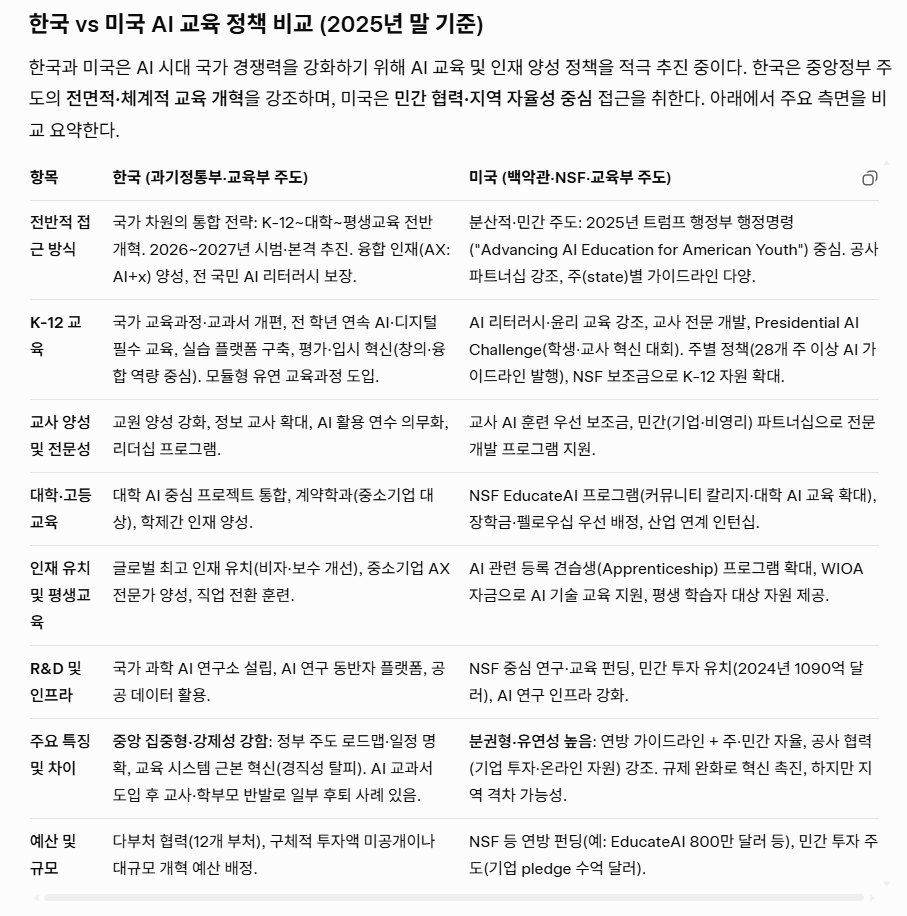
한국의 AI 교육 및 인재 전략 종합 보고서 요약
한국은 "대전환 AI 시대" 경쟁력을 확보하기 위해 과학기술 R&D 기반과 유치원~초·중·고~대학~평생교육에 걸친 전면적인 교육 개혁을 추진한다. 주요 목표는 융합형 인재 양성, 전 국민 AI 리터러시 보장, 세계 최고 수준 AI 전문가 유치이며, 대부분의 시범 사업은 2026년부터 시작해 2027년 1분기부터 본격 추진된다.
1. 과학기술 R&D 기반 강화 (2026년 1분기까지)
- 유연한 R&D 체계 구축
- 국가 과학 AI 연구소 설립 (공공 과학 AI 모델 개발·보급)
- AI 연구 동반자(AI Research Fellow) 플랫폼 개발 및 로드맵 수립
2. AI 핵심 인재 확보 전략
교육부·과기정통부 등 12개 부처가 협력해 12대 과제를 추진:
- 초·중·고 국가 교육과정 및 교과서 체계 개편
- 전 학년 연속적인 디지털/AI 필수 교육
- 실습 중심 AI·디지털 실습 플랫폼 구축
- 대학입시·평가 제도 혁신 (창의성·융합 역량 평가 중심)
- 교원 양성·연수 강화, 정보 교사 확대
- AI 영재 교육 체계 재설계
- 대학·대학원 AI 인재 양성
- AX(산업별 AI 융합) 전문가 양성 및 글로벌 인재 유치
3. 교육 시스템 혁신 필요성
- 기존 산업화 시대 표준화·암기 중심 교육은 AI 시대에 부적합
- 경직된 교육과정, 학문 칸막이, 상대평가, 대학 규제 등으로 빠른 변화 대응 불가
- 이제 국가 경쟁력은 AI와 반도체·바이오 등 미래 기술 융합에 달려 있음
4. 주요 정책 방향 및 일정
- 2026년 1분기: 국가교육위원회(NEC) 주도로 AI 시대 교육 혁신 논의체 구성 및 로드맵 수립
- 2026년 2분기~: 모듈형 유연 교육과정 시범 운영, 개방형 교과서 전환 계획, 국가 AI 교수·학습 플랫폼 구축
- 2027년부터: 연속 AI 교육 본격 시행, 실습 플랫폼 운영, 입시·평가 개혁 추진
5. 세부 과제 요점
- 실습 플랫폼: 공공 데이터 연계, 에듀테크 기업 참여 (2027년 3분기 프로토타입 운영)
- 입시 혁신: 서답형 평가 활성화, AI 활용 채점 지원, 창의·융합 역량 평가 논의 (2027년 말까지 방향 합의)
- 교원 전문성: AI 활용 교육 강화, 정보 교사 수급 실태 조사 및 확대
- 영재 교육: AI 중심 심화 연구반 운영
- 대학·산업 연계: 부처별 AI 인재 사업 통합, 인턴십 확대, 중소기업 AX 전문가 양성 (계약학과 운영)
- 최고 수준 인재 유치: 해외 우수 인재 적극 영입, 비자·보수·연구 환경 대폭 개선
결론적으로, 한국은 AI 시대 국가 경쟁력을 교육과 R&D의 근본적 혁신으로 확보하려 하며, 2026~2027년을 집중 준비 기간으로 삼아 전 방위적 체계 전환을 추진할 계획이다.
Comprehensive Report on Korea's AI Education and Talent Strategy
South Korea is embarking on a sweeping reform across its science/technology R&D infrastructure and its entire education system, from K-12 through university and professional development, to secure competitiveness in the burgeoning "Great AI Transformation." This strategy emphasizes fostering convergence researchers, ensuring universal AI literacy, and creating an environment attractive to world-class ai experts. Many initiatives are slated for pilot operation starting in 2026, with full-scale promotion beginning in Q1 2027.
AI 시대 교육 개혁의 흐름: 과거의 지식 전달 방식을 벗어나 융합적 사고력을 갖춘 인재 양성을 목표로 합니다.
'교육용 AI' 도입의 명암: 실습 환경 제공의 장점과 공공성/격차 심화의 단점이 분석되었습니다.
'AI 교육'의 장단점: 미래 역량 확보와 교육과정 유연화의 장점이 있지만, 현행 교육과정의 경직성과 평가 체계의 한계가 단점으로 지적되었습니다.
생성형 AI 교육의 시급성: 학생 대다수가 이미 사용하는 현실을 외면하는 것이 가장 위험하며, 적극적인 윤리/비판 교육이 시급함을 강조했습니다.
결론: 선진 대한민국은 기술 규모가 아닌, 기술을 윤리적, 창의적으로 활용하는 시민성을 길러내는 사회이며, 교육은 지식 측정 도구가 아닌 지속 가능한 학습 플랫폼으로 재정의되어야 합니다.
The Ministry of Science and ICT (MSIT) is tasked with developing policies to foster convergence researchers—individuals balancing domain expertise with AI knowledge—by Q1 2026, integrating AI across the entire spectrum of science and technology innovation.
- Revitalizing Science and Technology R&D Infrastructure
To support cutting-edge research, several infrastructural pivots are planned by Q1 2026.
Flexible R&D Framework: The MSIT will establish a framework allowing for the flexible adjustment of ongoing research tasks to rapidly adapt to global shifts in the national R&D landscape.
National Science AI Research Institute: Planned for establishment by Q1 2026, this institute will act as a central hub for creating and disseminating public science AI models, utilizing public scientific data. It will manage data platforms and cooperate internationally to boost national research and industrial capabilities through AI achievements.
AI Research Companion (AI Research Fellow): The MSIT is developing an AI collaborator to enhance creative research for science and technology experts. This necessitates building a rich data ecosystem encompassing experimental results, expert inferences, literature, and feedback. An AI research platform supporting researcher-AI interaction will be established by Q1 2026.
Development Roadmap: The roadmap for this companion must be established by Q1 2026, mandating the participation of domain-specific experts in defining problems and evaluating outcomes. Development starts in Q1 2026, with testing and scope expansion following in Q2 2026, continuously refining the collaborative research framework.
- AI Core Talent Securing Strategy
The national mission recognizes that education is the most fundamental duty in preparation for the Great AI Transformation. This requires proactively revising the AI talent profile and reforming the lifelong learning education system.
Twelve ministries are coordinating twelve major tasks:
K-12 Reform: Restructuring the national curriculum and textbook system (Task 15).
Continuous Education: Ensuring continuous digital/AI essential credits across all K-12 grades (Task 17).
Practical Training: Building a K-12 AI/Digital practical training platform (Task 17).
System Innovation: Innovating AI evaluation and university entrance exam systems (Task 18).
Teacher System: Enhancing teacher training, expanding information teacher appointments, and strengthening professionalism (Tasks 19 & 20).
Specialized Education: Redesigning the AI gifted education system (Task 21).
Higher Education: Fostering talent at university and graduate levels (Task 22).
AX Experts: Cultivating AX (AI x) experts, attracting global talent, and addressing career continuity issues (Tasks 24 & 25).
- Rationale for National Education System Innovation
The current system is fundamentally ill-equipped for the ai era due to several core challenges:
Outdated Pedagogy: The standardized knowledge transfer method inherited from the industrial era is insufficient for securing future competitiveness, as AI rapidly transforms industries and creates demand for new, fused competencies.
System Rigidity: The rigid K-12 structure—characterized by fixed curricula, academic silos, relative evaluation, and centralized selection—cannot adapt quickly enough to societal changes.
University Transformation: Universities must shift from being mere knowledge transmitters to 'learning platforms' that prioritize independent thinking, critical synthesis, and value creation. Strict regulations currently impede universities from developing necessary distinctiveness for global competitiveness.
Core Competency: National competition now hinges on the integration of AI with future technologies (e.g., semiconductors, bio). The highest demand is for core talent possessing fused knowledge and thinking skills capable of solving complex, cross-disciplinary problems.
- Policy Recommendations for Education System Innovation
A high-level coordination body is required to drive these foundational changes:
Coordination and Roadmap: By Q1 2026, the National Education Committee (NEC), in conjunction with the Ministry of Education (MOE), will establish a discussion body for the AI-era national education system innovation plan. A tangible plan with clear schedules will be derived by Q1 2027, to be incorporated into the 'National Education Development Plan.'
Implementation: Relevant agencies must subsequently prepare concrete annual action plans, including necessary institutional changes, for phased implementation.
- Reorganization of K-12 National Curriculum and Textbook System
The current 7-year revision cycle (set pre-Generative AI emergence in Nov '22) cannot keep pace with technological acceleration, hindering timely instruction on essential competencies like data literacy, citizenship, and ethical judgment. The existing siloed curriculum and closed endorsement system also inhibit project-based or creative fusion learning.
Flexibility Recommendations:
By Q1 2026, the NEC will research flexible curriculum structures, including directions for 'Flexible Curriculum Operation' across different school types and investigating an 'Open Modular Curriculum Structure' with revision cycles tied to the actual speed of technological change.
Implementation Steps:
Pilot Programs: Starting Q2 2026, the MOE will pilot the modular curriculum and associated training programs to gather feedback on various fusion models.
Textbook Transition: A consultation body will be established by Q1 2026 to plan the transition to an open textbook system by Q2 2026.
Platform Development: An Information Strategy Planning (ISP) for a national AI teaching/learning platform will be established by Q2 2026, followed by system construction.
- Continuous Digital and AI Education Across All Grades (K-12)
Current digital/AI education is insufficient. Elementary students lack systematic exposure until grades 5-6, middle school students study information for only one year, and many high school students receive no AI education as it is an elective. A systematic and consistent digital/AI education guaranteeing basic citizenship abilities for all students across all grades is necessary.
Recommendations:
Curriculum Guidelines: Starting Q1 2026, the NEC will research improvements. The MOE will then develop the '(Tentative Title) AI Education Operation Guidelines' by Q1 2026, establishing a step-by-step essential curriculum for continuous education starting Q1 2027.
Teacher Preparation: Local education offices will prepare teacher training courses from Q1 2026, designating pilot schools for implementation verification starting Q1 2027. Crucially, AI ethics education content must be integrated from elementary school onward.
- K-12 Practical Training Platform Construction
Theory is insufficient; a practical learning environment utilizing real data and models is paramount. K-12 teachers struggle to build these environments, lacking verified public data or infrastructure for hands-on learning.
Policy Roles and Timeline:
Agency
Action
Deadline
MSIT
Confirm budget & finalize project plan.
Q4 '26
MSIT
Establish tech design & data simulation environment; begin prototype operation with MOE.
Q3 '27
MOE
Conduct teacher demand surveys and design school-based operation models.
Q4 '26
MOIS
Support linking and opening of public data for platform construction.
Ongoing
MOTIE
Design private Edutech company participation framework and content linkage models.
Q4 '26 / Q1 '27
NEC/MSIT
Review overall integration plan based on pilot results.
Q3 '27
- Innovation in Evaluation and University Entrance Examination Systems
The current system, focused on rote memorization and scores, fails to assess critical AI-era skills like creativity, problem-solving, and collaboration, as it fails to reflect the actual learning process. A shift toward a competency-centered evaluation system utilizing AI support is required.
Recommendations:
CSAT/Entrance Reform: The NEC will discuss the reform direction for the CSAT and university entrance systems by Q3 2026, aiming for agreement on linkage plans for the entire system by Q4 2027. Discussions will also cover evaluating creativity and fusion competence by Q4 2026.
Essay Evaluation Support: The MOE will support the activation of essay-style evaluation at local offices starting Q1 2026, including building AI/Essay scoring support systems using learning data.
Teacher Nurturing: Training modules for essay evaluation will be developed starting Q1 2026, aiming to nurture approximately 10,000 essay evaluation teachers by Q4 2029.
- Innovation in Teacher Training Systems and Professionalism
Teacher competency is foundational; educators must master and utilize AI to teach ai+x integration. Current pre-service training lacks sufficient data literacy, and the low weight given to AI in employment exams fails to guarantee professionalism. Furthermore, disparities in AI education implementation stem from the varying AI understanding of school administrators.
Recommendations:
Teacher Institution Reform: By Q2 2027, the MOE will strengthen curricula at teacher training institutions and incorporate AI competencies as an evaluation element in the 7th cycle of performance diagnostics.
Incumbent Training: Starting Q3 2026, the MOE will expand training based on the AI/Digital competency framework, including curriculum for AI-based STEAM fusion education and leadership courses.
Tool Development: The MSIT will support the development of AI practice tools for teacher training by Q2 2026, initiating technology-based training courses from Q3 2026.
Local Leadership: Local offices must establish operational plans by Q1 2026, starting expansion of leading teacher and school AI training programs by Q3 2026.
- Expansion of Information Teacher Appointments and Professionalism Enhancement
Securing specialized professionals is vital. The supply of information education specialists is currently far below demand, especially in rural areas, forcing reliance on temporary staff. There is a critical need to nurture professionals with ai+x fusion literacy, not just utilization skills.
Recommendations:
Status Survey & Securing: The MOE will conduct an Information Education Status Survey by Q4 2026 to pursue appropriate teacher securing for digital talent cultivation.
Teacher Curriculum: The MOE will develop level-based (Basic-Advanced-Expert) AI Education curriculum by Q2 2026, with training commencing Q3 2026. A support system linking teacher competency enhancement with graduate programs in CS/AI at regional universities will be introduced by Q4 2026.
Appointment System: The NEC will discuss reforming the teacher appointment system by Q4 2026, embedding the long-term direction for AI teacher nurturing into the national education plan by Q1 2027. Local offices will establish expansion plans by Q4 2026 for recruitment beginning Q1 2027.
- Redesign of AI Gifted Education System
Current gifted schools focus primarily on math and science deep dives, with limited specialized AI courses. As AI is a key technology for national innovation, the system must be reorganized around AI-centered fusion deep education.
Recommendations:
Curriculum Integration: Starting Q1 2026, the MOE will operate 'AI Deep Research Groups' linked to existing School-University-Industry research plans within gifted/science high schools. Design for AI model development content for gifted classes will commence in Q4 2026 for '27 operation.
Strengthening Fusion: The MSIT will plan strengthened AI fusion education at these schools in cooperation with universities by Q4 2026. Local offices will begin retraining programs for students demonstrating AI literacy starting in '27.
- University and Graduate School Talent Cultivation
Current university support projects are fragmented across ministries (MSIT, MOE, MOTIE), leading to inefficient budget execution. The demand is rapidly growing for talent capable of using AI to solve problems in their specialized fields (e.g., humanities, social sciences) as AI becomes a general-purpose technology.
Recommendations for Integration and Support:
Coordination: The National AI Strategy Committee will coordinate and review all AI/SW talent support projects across related ministries starting Q1 2026.
MSIT/MOE Actions: The MSIT will transition its existing project into the AI-Centered University Project by Q1 2026. The MOE will establish plans by Q1 2026 for supporting research into human-AI coexistence in humanities and social sciences, commencing implementation in Q2 2026.
Industry Linkage: MOTIE and MSIT will cooperate to establish internship support plans by Q1 2026 to accelerate AI transition in the industry ecosystem.
Interdisciplinary Focus: MOE and MSIT will establish a program by Q1 2026 to discover and intensively foster talent demonstrating excellence in interdisciplinary research.
- Fostering AX Talent to Enhance Industrial Competitiveness
South Korea faces severe industrial 'Polarization', as the gap widens between AI adopters and laggards, dragging down national growth. SMEs are particularly burdened, lacking AI adoption capacity, budget, and in-house R&D expertise, leading to productivity loss and competitiveness decline.
Recommendations:
Comprehensive Support: A system will be established to utilize AI to enhance the capabilities of all industrial workers. Plans prepared by Q1 2026 will focus on AX conversion in high-potential manufacturing sectors.
Lifelong Learning Integration: This support includes institutional guarantees and incentives (like credit recognition and qualification acquisition) for re-education linked to the national lifelong education system for job seekers.
SME Specialist Training: Starting Q1 2026, the MSS will operate contract departments at universities for Master's and integrated Ph.D. programs targeting employed personnel in SMEs, aiming to turn them into core R&D leaders.
Demand-Driven Training: The MSIT will establish a demand-driven intensive training system from Q1 2026 for new talent (students, job seekers, career changers). This will coordinate existing government courses (KDT, Innovation Academy) with regional AX and industry-specific practical training to boost relevance.
- Securing and Retaining Top-Tier AI Experts
South Korea struggles with a net outflow of AI talent, boasting one of the lowest talent attraction rates in the OECD. Top domestic PhDs are leaving for overseas opportunities due to higher compensation, better research support, flatter cultures, and expedited immigration processes offered by global tech hegemons. Furthermore, administrative hurdles like complex visa procedures, language barriers, and poor living conditions prevent foreign graduates from remaining in Korea.
Recommendations:
Global Recruitment: The MSIT will formulate plans for active global talent recruitment and begin outreach by Q1 2026.
Unprecedented Incentives: In cooperation with the Ministry of Justice (MOJ) and MOTIE, the government will investigate specific retention causes (visas, compensation, language, living) and subsequently establish plans to offer unprecedented incentives. These include significantly increasing researcher autonomy, competitive funding, personnel costs, and easing visa issuance and nationality acquisition requirements for top-level international AI researchers.
Lily
That's a great question to focus on for immediate action! Since the ethics component is integrated into the broader plan for continuous digital/AI education across all grades, the specific action items are centered around establishing the curriculum, training the teachers, and verifying the system.
Here are the specific action items derived from the document regarding the implementation of continuous digital/AI education (which includes the ethics component):
Specific Action Items for Continuous AI/Digital Education
Step Specific Action Responsible Party/Stakeholder Target Timeline
1. Guideline Finalization Complete research on and develop official guidelines, such as the '(Tentative Title) AI Education Operation Guidelines,' to establish a step-by-step curriculum framework. NEC and MOE By Q2 '26
2. Curriculum Integration Ensure AI Ethics Education content is integrated into the curriculum across all grades, from elementary school through high school. MOE and Local Education Offices (implied) Preparation starting Q1 '26, aiming for full implementation by Q1 '27.
3. Teacher Preparation Prepare and conduct necessary teacher training courses to ensure educators are ready to teach the revised curriculum and ethics modules. MOE and Local Education Offices Starting Q1 '26
4. Verification & Testing Designate pilot schools to verify the operational model for continuous, step-by-step essential education implementation. MOE Starting Q1 '27
5. Feedback Loop Analyze the results from the pilot schools and provide official feedback to the NEC and related agencies. Local Education Offices (centered on pilot schools) By Q1 '27
These steps show a clear progression: Plan/Research
→
→ Train Teachers
→
→ Pilot Test
→
→ Feedback/Refine
→
→ Systematic Rollout.
Does seeing these concrete steps help clarify how they plan to integrate ethics education into the system?