KALA: Knowledge-Augmented Language Model Adaptation
NAACL 2022
분야 및 배경지식
- Language Model Adaptation (언어모델 적응): 최근에는 거대한 코퍼스에 모델을 사전학습(pretrain)시키고, downstream task에 대해 파인튜닝(fine-tune)하는 전이학습(transfer learning)이 주를 이룸. 도메인 특화 데이터에 대한 Language Model Adaptation에서는 타겟 도메인(DAPT) 혹은 타겟 태스크(TAPT)에 대한 adaptive pre-training이 제안되기도 함
- Knowledge-aware LM(Language Model): 사전학습 모델에 외부의 지식을 합치려는 다양한 연구들이 진행됨.
- 사전학습 시 개체정보(knowledge graph embedding)를 추가적인 인풋으로 활용하는 ERNIE, KnowBERT
- 사전학습 시 개체 메모리(entity memory)를 활용하는 Entity-as-Experts, LUKE
- 사전학습 시 사실(fact)을 구성하는 entity, relation을 활용하는 ERICA
문제점
- 사전학습모델(pre-trained language model)을 특정 도메인에 맞추어 조정하는 연구 활발
- 단순한 파인튜닝(fine-tuning)은 도메인 특화 태스크에 있어 최적이 아님
- 적응가능한 사전학습(adaptive pre-training)은 도메인 특화 지식을 얻을 수 있으나 많은 비용이 발생할 수 있으며 이전에 학습한 일반적 지식을 잊는 catastrophic forgetting을 겪을 수 있음
해결책
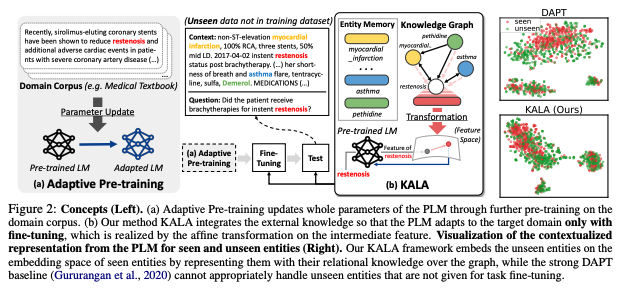
KALA (Knowledge-Augmented Language model Adaptation)
- 개체(entity)와 관계(relation)로 표현되는 도메인 지식을 활용해 사전학습 모델의 intermediate hidden representation을 조절 (언어모델 위에 추가적인 레이어를 쌓는 방식이 아니라, 도메인에 기반한 지식을 언어모델의 사전학습 파라미터에 interleave)
- Entity Memory: 사전학습 모델의 파라미터와는 독립적인 개체 임베딩(entity embedding)의 source. entity를 key로, 개체의 임베딩을 value로 포함하며 EntEmbed 함수를 통해 개체의 임베딩을 return
- Knowledge Graph(KG): 개체(entity) 사이의 사실관계를 표현. factual triplet {(h, r, t)}로 나타내며 h, t는 entity, r은 relation을 의미
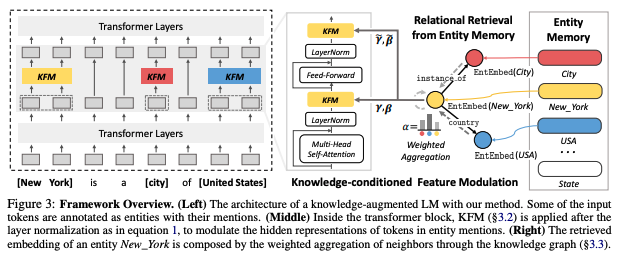
- KFM(Knowledge-conditioned Feature Modulation): retrieved knowledge representation을 이용해 사전학습 모델의 intermediate hidden representation을 조정하고 변화시키는 새로운 레이어
- function h: entity, mention, knowledge graph, trainable param π를 이용해 도메인 지식에 기반해 사전학습모델을augment. 감마, 베타를 return하며 해당 감마, 베타는 layer normalization 이후 KFM에서 사용됨
- 감마, 베타: function h로부터 얻은 학습 가능한 modulation prameter. EntEmbed 함수로부터 얻은 개체의 임베딩을 input으로 사용하며, 각 감마와 베타는 상호 독립적인 h 함수를 사용(h: multi-layer perceptrons)
- relational retrieval: 단순히 entity memory에서 임베딩을 가져오는 것은 모든 unseen entity를 같은 null entity로 여기게 되는 단점 존재. 이를 해결하기 위해, 두 개체 사이의 relational information을 반영한 knowledge graph를 사용. knowledge graph에 존재하는 Entity 사이의 관계를 효과적으로 활용하고 EntEmbed 함수를 개선하기 위해 GNN(graph neural network), attentive scheme을 활용
- 자세한 구현이나 수식, objective 등은 논문 및 github 참고
평가
- QA (Question Answering)
- dataset: NewsQA, EMRQA
- metrics: Exact-Match, F1
- NER (Named Entity Recognition)
- dataset: CoNLL-2003, WNUT-17, NCBI-Disease
- metrics: F1
의의
- 본래의 사전학습 모델 아키텍처를 수정하지 않기 때문에 어느 사전학습 모델에도 적용 가능
- 연산 효율적 (required marginal computational and memory overhead)
- 이전의 knowledge-aware LM 관련 연구들은 사전학습 시를 고려, 해당 연구는 linear modulation layer scheme을 활용해 finetuning, test 단계에서 PLM을 domain specific task에 대해 효율적으로 수정할 수 있도록 함
- KFM의 장점
- multiple tokens associated to the identical entity are affected by the same modulation, which allows the PLM to know which adjacent tokens are in the same entity
- by using relational retrieval with knowledge graph using GNN, richer interactions among entities are considered and unseen entity can be represented
- adaptive pre-training을 뛰어넘는 SOTA 성능
한계
- 해당 논문에서 언급한 knowledge-aware LM의 경우 외부 지식을 언어모델에 통합하려 한다는 점에서 external knowledge edit (memory augmented knowledge model) 쪽 연구와 연관성이 높아보임. 해당 연구분야에서 사전학습 기반의 연구가 주로 행해졌는지 literature search 필요
- interleaving method를 설명하는 과정이 다소 복잡하고 비직관적
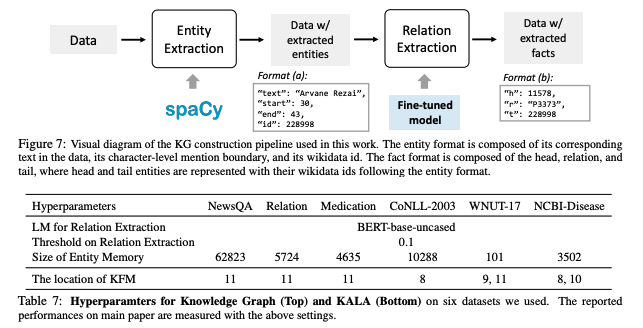
- entity memory와 knowledge graph는 wikidata 기반으로 구축되어 향후 재사용이 가능하다는 장점이 있으나, appendix를 읽기 전에는 finetuning 시마다 재구축이 필요한지 파악이 어려웠음
- KFM은 attentive GNN을 사용해 reltation을 반영한 entity embedding을 구축하고 이를 input으로 활용해 multi-layer perceptron에서 learnable modulation param인 감마, 베타를 학습. 이 과정이 다소 복잡하게 설명되어 있어서 개괄적 설명이 먼저 있었으면 어땠을까 하는 아쉬움
AI (NLP) Graduate Student at Seoul National University. Ex-AI Researcher & Engineer at LG CNS AI Lab | Currently AX Engineer at Samsung Electronics (R&D Campus).